
Bitters: what they are and which you need
A few drops that change a whole drink. What bitters are, where Angostura and Peychaud’s come from, how much a dash is and which ones to keep at home.
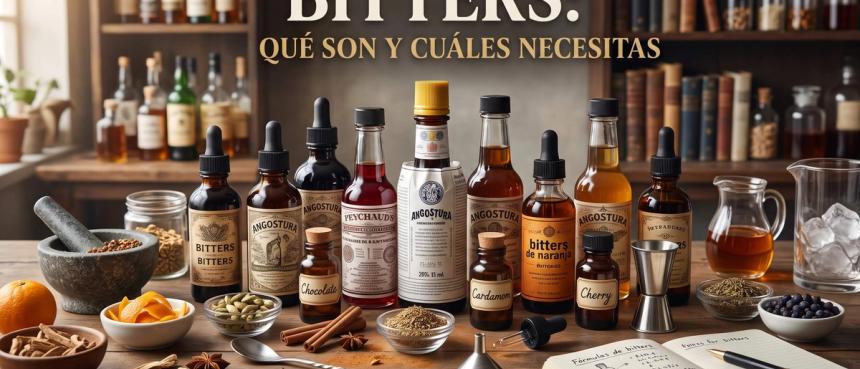
Half the classic cocktail list calls for an ingredient measured in dashes that hardly anyone keeps at home: bitters. Two or three shakes of a small bottle, barely a couple of millilitres, and without them an Old Fashioned is whiskey with sugar and a Manhattan is whiskey with vermouth. With them, the drink has depth.
What they are
Bitters are a highly concentrated infusion of barks, roots, spices and citrus peel in high-proof alcohol. Nearly all of them rest on a bitter plant — gentian is the most common — and build their character on top of it: cinnamon and clove, anise, orange, cacao.
They are not drunk on their own, and are not meant to be. They work like salt in cooking: you do not taste them as one more flavour, but they tie the others together and make the drink feel rounder, less sweet and longer on the palate.
Nor are they a modern addition; they are part of the original definition. The first time a cocktail was described in print, in 1806, it was as a mix of spirit, sugar, water and bitters. That is, almost word for word, the recipe for an Old Fashioned.
The three worth knowing
Angostura
The bitters by definition, and the one behind nearly every recipe that just says “bitters”. It was created in 1824 by Johann Siegert, a German doctor posted to the Venezuelan town of Angostura — now Ciudad Bolívar — as a remedy. His sons moved production to Trinidad in 1875, where it remains. It tastes of warm spices, with clove and cinnamon up front.
In this collection it goes into the Old Fashioned, the Manhattan, the Rob Roy, the Whisky Sour and the Pisco Sour, where it is dropped onto the foam and is the first thing you smell.
Peychaud’s
The New Orleans one. It was created in the mid-nineteenth century by Antoine Amédée Peychaud, a Creole apothecary who had come to the city from Saint-Domingue, today’s Haiti. It is lighter and sweeter than Angostura, bright red and heavy on anise. It is essential in only one cocktail, but an important one: the Sazerac, which does not exist without it.
Orange bitters
Third in importance, and the one fewest people own. It is dry and citrusy, and it was what many early Martini recipes called for before the drink became so dry. A drop in a Dry Martini or an Old Fashioned shifts the accent without changing the drink.
How much is a dash
A dash is what comes out when you flip the bottle and shake it once, firmly. From an Angostura bottle with its dasher cap it is around 0.8 ml, but it varies a good deal with the bottle, the cap and how full it is: measurements range from 0.2 to 1 ml. That is why recipes count dashes rather than millilitres. It is a measure of gesture, not of precision.
A drop is much less. When a recipe says “a few drops” — as the Pisco Sour does for its foam — it means single drops, not dashes.
Do they contain alcohol?
Yes, and plenty: Angostura is 44.7% ABV, stronger than many whiskies. In cocktail quantities its contribution is tiny, but it is not zero, and that matters in alcohol-free drinks. A mocktail with two dashes of Angostura is no longer strictly alcohol-free, and for someone who cannot drink at all, that is not a detail. For those cases there are alcohol-free bitters, made with glycerine.
Which to buy first
If you only keep one, Angostura: it is in most of the classics and a bottle lasts years. The second, Peychaud’s if the Sazerac appeals, or orange bitters if you drink Martinis. Beyond that a whole world opens up — cacao, celery, cardamom — but those three cover almost every recipe here.
There is no need to keep them in the fridge. At that strength they last for years in a cupboard, out of the sun.