What a twist means in cocktails
The word means two different things: the citrus peel twisted over the drink, and the variation on a classic. Here are both, and how to do each one properly.
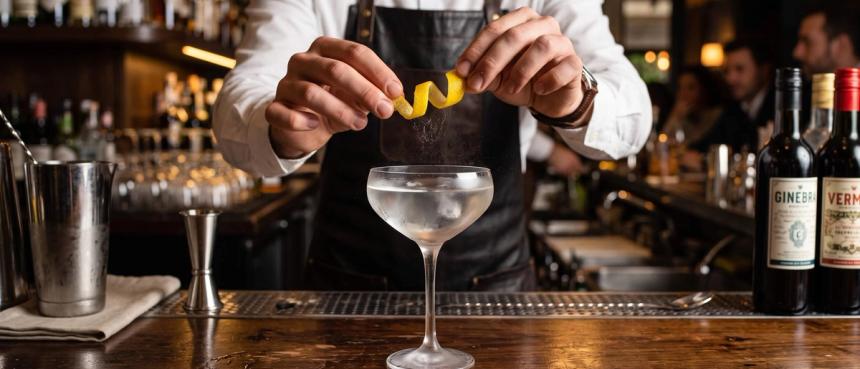
Behind a bar, “twist” means two completely different things, and they have nothing to do with each other. The confusion is common enough to be worth clearing up first.
1. The twist as a strip of citrus peel
This is the older and more literal meaning: a strip of lemon, orange or grapefruit peel twisted over the drink. That is what the word describes — the twisting.
And it is not decoration. Twisting the peel bursts the glands in the rind and throws out a fine mist of essential oils that lands on the surface of the drink. That oil is pure aroma, and aroma is most of what we call flavour. It is why a Martini with a twist and one without taste different even though the liquid is identical.
How to do it properly: cut a wide strip with a peeler, stopping short of the white pith, which is bitter. Hold it skin-side down about a hand’s width above the surface and snap it in half. With a light to the side you will see the oils flash. Then run the peel around the rim and drop it in, or discard it if you only wanted the aroma.
When someone orders “a vodka with a twist” or “vermouth on the rocks with a twist”, this is what they are asking for: the drink neat over ice, with lemon oil expressed over the top.
2. The twist as a variation on a classic
The other meaning is more recent, and it is the one used when talking about recipes. A twist is a classic cocktail with one piece swapped out: you replace an ingredient, you keep the structure, and the result explains itself to anyone who knows the original.
A Boulevardier is a Negroni with bourbon instead of gin. A Rob Roy is a Manhattan built with Scotch. A Gold Rush is a Whiskey Sour where honey takes the place of the sugar. In all three the parent recipe is still audible underneath, and that is the point of it.
They are grouped by their original on the twists on the classics page.
What separates a twist from an invention is that discipline: you change one thing, not four. Alter the spirit, the sweetener and the acid at once and you are no longer varying anything — you are writing a new recipe, which is also fair enough, but it is a different exercise.
Why twists are the fastest way to learn
Making a classic and then its variation, one after the other, teaches more than ten unrelated recipes. Changing a single piece lets you taste exactly what that piece was doing: what the gin brought that the bourbon does not, how honey differs from sugar, how much weight a vermouth really carries.
It is the quickest route from following instructions to understanding why they work.
How to invent your own
Three rules are enough:
- Pick a classic you already make well and whose flavour you remember precisely.
- Change ONE ingredient for another with the same job: a spirit for a spirit, a sweetener for a sweetener, a citrus for a citrus.
- Taste it against the original in the same sitting, because nothing can be compared from memory.
If the swap moves the sweetness or the acidity — honey sweetens harder than sugar, grapefruit is less sharp than lime — adjust the quantities before writing the drink off. Almost every failed twist is really an unrebalanced one.