The true story of the Margarita
Five people claim to have invented it and none can prove it. But a 1936 newspaper clipping, a casino in Tijuana and a clumsy translation explain its origin far better than any of the legends.
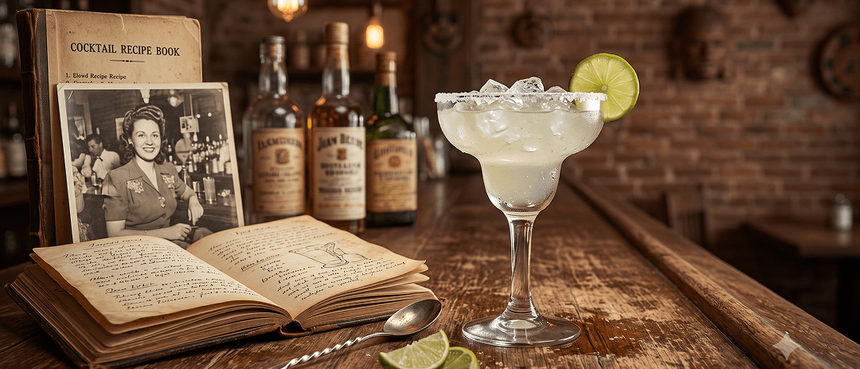
Ask about the origin of the Margarita at any bar and you will get a lovely story. The problem is you will get a different one at every bar, and not one of those stories has a single document behind it. The curious part is that the most likely explanation has no author at all: it is buried in a 1936 newspaper clipping and a translation made carelessly.
The two legends everyone repeats
The first version places the invention in 1938, at a restaurant between Tijuana and Rosarito. Its owner, Carlos "Danny" Herrera, supposedly created the drink for a customer who was allergic to every spirit except tequila and refused to drink it neat. Herrera mixed tequila with lime and orange liqueur, served it with a salted rim, and named it after her.
The second points to 1948 and a house in Acapulco. Margarita Sames, a wealthy Texan hostess with a good hand, served her guests a mix of tequila, Cointreau and lime. Among those guests was Tommy Hilton, of the hotel chain, who took the recipe back to his bars and the name of the woman who made it along with it.
Both stories share the same flaw: they were told decades later, without a menu, a receipt or a photograph to back them up. And both share a bigger problem, which is what comes next.
The lead that does have paperwork
By the end of the nineteenth century there was an entire family of cocktails called the Daisy. The formula was fixed: a spirit, citrus juice, orange liqueur and sometimes a splash of soda. They were made with gin, with brandy, with whiskey. They were so common that in 1939 an Albuquerque newspaper described them as ubiquitous.
Now the part that changes everything: "daisy", in Spanish, translates as "margarita".
A Daisy made with tequila is, quite literally, a Margarita. And the first documented mention of a Tequila Daisy appears on 23 July 1936, in the Moville Mail, where the journalist James Graham recounts his stay in Tijuana. That is two years before Danny Herrera and twelve before Margarita Sames.
Why it all happens on the border
That the trail leads to Tijuana is no accident. During Prohibition, with the United States legally dry, thousands of Americans crossed the border every weekend just to drink. And on the other side an entire infrastructure was waiting for them.
Agua Caliente — casino, hotel and racetrack just outside Tijuana — was the symbol of that era. American cocktails made with the local spirit were served there, and among them a Tequila Daisy. American bartenders working in Mexico, with American recipes and Mexican tequila: the Margarita was not invented at a table, it was forged on a border.
Seen this way, the dispute between Herrera and Sames stops making sense. Neither of them was probably lying. They simply served, each on their own, a drink that was already circulating, and named something that already had a name.
How a classic ended up coming out of a machine
The Margarita conquered the United States, and that success nearly ruined it. In the seventies and eighties came the frozen machines and, with them, sour mix: an industrial lime-and-sugar preparation that made it possible to serve hundreds of drinks a night without squeezing a single piece of fruit.
For two decades, for much of the world, a Margarita was exactly that: something green, very sweet and very cold that came out of a tap. Its recovery arrived with the revival of classic cocktails and with 100% agave tequila, which gave the drink back the ingredient it should never have lost.
How to spot a good one
There are four signs and you can spot them before the first sip. The bottle says 100% agave, not merely "tequila". The lime is squeezed in front of you. The orange liqueur is an actual liqueur, not a syrup. And the salt covers only the outer half of the rim, so you decide how much you get with each sip.
If all four hold, what you are holding closely resembles what someone was ordering in Tijuana in 1936. Nobody knows who invented it. But at least now we know where the name came from.