The mixing glass and the bar spoon
For drinks made only of spirits, stirring is not a gentler alternative to shaking: it is the only correct technique. And it is done wrong almost every time.
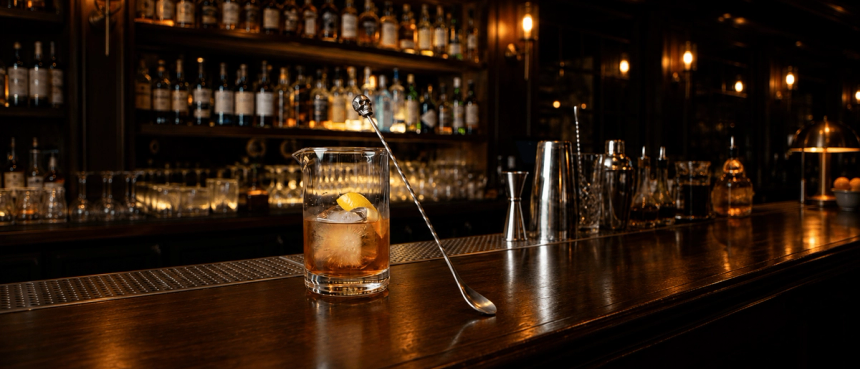
A shaken Manhattan is not a colder Manhattan: it is a cloudy one, full of tiny bubbles and a gritty texture that lingers for the first few minutes. The difference between shaking and stirring is not one of intensity but of outcome, and it depends entirely on what is in the drink.
The rule that settles it
Shake anything with citrus, dairy, egg or fruit: those ingredients need to emulsify and combine, and the air that gets whipped in is part of the result. Stir anything made only of spirits and liqueurs: Manhattan, Negroni, Martini, Old Fashioned.
The reason is clarity. Shaking shatters the ice into microscopic shards and suspends air in the liquid, which clouds it. In a drink made only of spirits, that cloudiness adds nothing and takes something away: the mouthfeel goes from silky to rough.
The correct technique
Hold the spoon between your middle and ring fingers, not like a pencil. The spiral of the handle should rotate against those two fingers while your wrist barely moves. The back of the spoon stays in contact with the wall of the glass throughout.
You are not stirring the liquid: you are rotating the ice. If the cubes clatter against each other, you are doing it wrong and breaking ice. Done properly, the sound is a continuous hiss and the surface barely moves.
Twenty-five to thirty seconds is the benchmark with decent-sized ice. Under twenty and the drink comes out harsh and unintegrated; over forty and it starts to water down.
Dilution is an ingredient
A properly stirred drink takes on twenty to twenty-five percent water. That is not a flaw to be tolerated: it is part of the recipe. An undiluted Manhattan is harsh spirit; with the right dilution, the aromas of the vermouth and whiskey open up and the drink becomes drinkable. That is why the classics were calibrated assuming that percentage.