Back to the classics
After a decade of smoke, tweezers and twelve ingredients per drink, the industry is reversing course. It is not nostalgia: maximalism simply stopped impressing anyone, and bars discovered that the hard part is not surprising someone, it is getting them to come back.
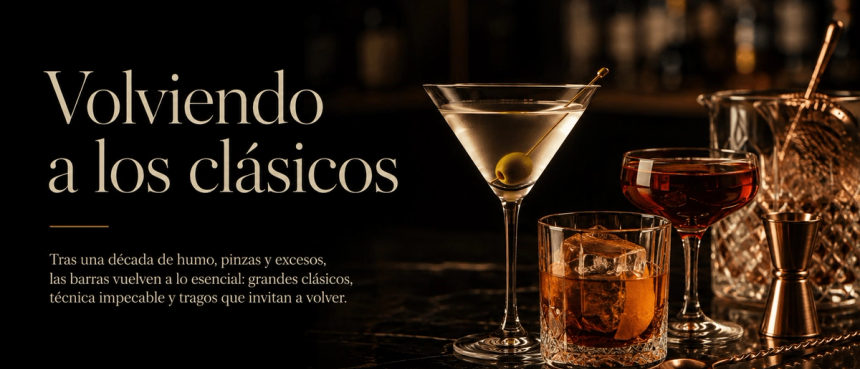
There was a moment, somewhere in the last decade, when ordering a cocktail became attending a demonstration. It arrived under a glass cloche full of smoke, with tweezers placing an edible flower, alongside a menu explaining milk clarification across three paragraphs. It was good. It was almost always good. But it took twenty minutes and you did not want a second one.
The exhaustion of "look what I can do"
Several bartenders share the same diagnosis heading into 2026: the era of five-plus component builds and elaborate garnishes is giving way to something else. Not to worse technique, but to technique that does not put itself on display.
The reasoning has impeccable commercial logic. A spectacular drink wins the first visit. A balanced drink wins the tenth. And a bar lives off the tenth, not the first. The shift is not aesthetic: it is a change of objective, from impressing to retaining.
There is also a practical factor rarely mentioned in interviews: a twelve-step drink is impossible to sustain on a Saturday at eleven at night with three rows deep at the bar. Maximalist menus worked in small venues with a limited clientele. As soon as volume rises, consistency collapses, and a badly executed classic shows far more than a badly executed invention, because the customer knows what it is supposed to taste like.
Going simple is not going easy
This is the nuance the headline loses. A Daiquiri has three ingredients and nowhere to hide: if the rum is mediocre, you notice; if the lime was squeezed two hours ago, you notice; if the glass was warm, you notice. Complexity covers flaws, simplicity underlines them.
That is why the return to the classics is arriving alongside an obsession with product and ice. If you are going to serve a Negroni and nothing else, the vermouth has to be immaculate, the ice has to be clear and the dilution has to be exact. There is no margin left.
What this means for your home bar
If you are starting out, the trend works in your favour: the best use of your time is not learning twenty recipes but executing five flawlessly. A well-made Daiquiri, Negroni, Old Fashioned, Whiskey Sour and Gin & Tonic will cover almost any occasion and almost any guest.
And if you have been at this a while, the lesson is probably the opposite of what you expected: before buying the smoking gun, buy better ice. Before learning milk clarification, learn to measure. What separates a home drink from a bar drink is almost never an exotic technique; it is rigour in the three or four boring decisions nobody photographs.